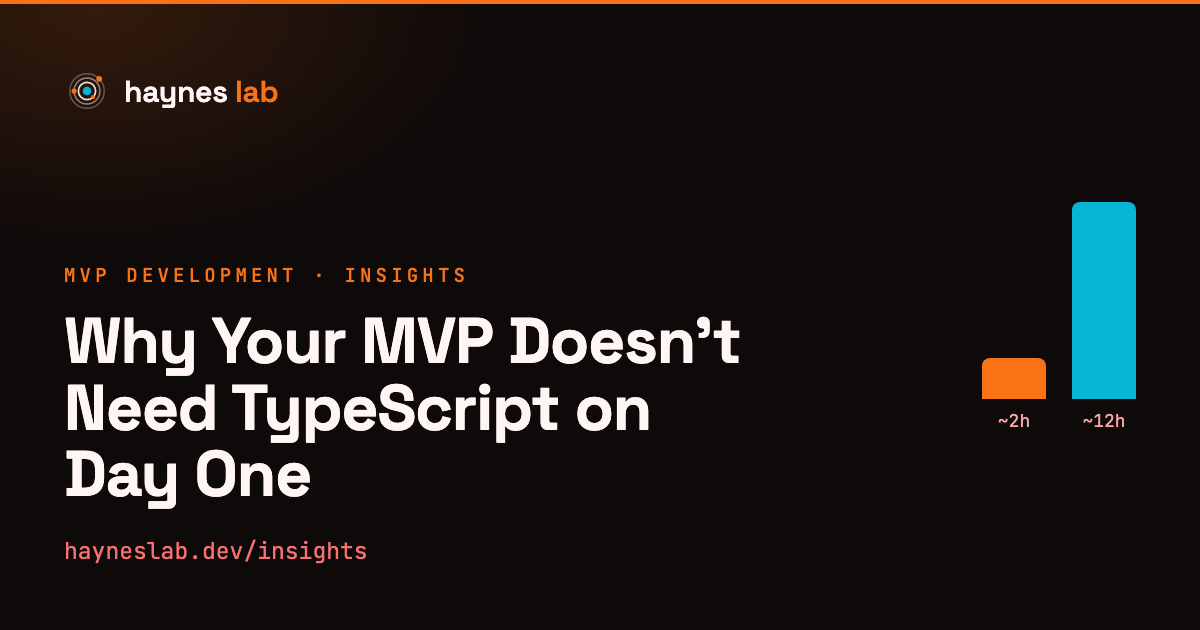
Plain JavaScript ships your MVP faster, and the founders who insist on TypeScript from line one usually spend their first week fighting the compiler instead of finding out whether anyone wants the product.
That's the claim. Here's the qualification, because it matters: there are exactly three cases where we'd wire up TypeScript before the first feature ships. If your MVP hits one of them, skip the rest of this post and turn strict on today. If it doesn't, the type layer is overhead you're paying before you've earned it.
The cost of TypeScript at MVP scale
TypeScript isn't free. The bill comes due in three places, and at MVP scale all three are working against you.
Setup and config. A tsconfig.json, build tooling, type stubs for half your dependencies, and the inevitable afternoon spent on why a working library ships broken types. None of that is product.
Type fights. Early MVP code changes shape weekly. The data model you typed on Monday is wrong by Thursday, and now every rename is a compiler errand across fifteen files before the app will even run. Plain JS lets the shape stay liquid while you're still learning what it is.
Slower iteration. The whole point of an MVP is the loop: ship, watch a real user, change it. Anything that adds friction to that loop is the enemy this month. Types add friction at exactly the moment you most want none.
The chart isn't an argument that TypeScript is bad — it's the most-loved language on the leaderboard for good reasons. It's an argument about order of operations. Types pay off when code is large, shared, and stable. MVP code is small, solo, and changing daily: the exact conditions where the payoff hasn't arrived yet.
When plain JS is the right call
Reach for plain JavaScript when you're building any of these:
- A proof of concept you might throw away in two weeks. Don't type code you're auditioning.
- A demo for a pitch or a design partner. It needs to work on the screen, not survive a refactor.
- A fast prototype to test one assumption. One screen, one flow, one question answered. Types add zero signal to "do people click this."
In all three, the codebase is small enough to hold in your head and short-lived enough that the type tax never amortizes. A modern editor plus a few JSDoc hints covers most of what you'd want types for, at none of the build cost.
The three cases TypeScript is non-negotiable on day one
Now the qualification. We've watched these three categories burn teams that shipped them untyped, and we'd never start them any other way.
1. Payments. Money math, currency units, and Stripe webhook payloads are exactly where a silent undefined becomes a refund ticket or a double charge. The cost of a runtime bug here is measured in dollars and chargebacks, not a console error. Type the money.
2. Multi-tenant data. The moment one customer's query can return another customer's row, you have a leak — and it's invisible until a user reports it. Types that pin a tenantId to every row and every query are the cheapest guardrail you'll ever install against the most expensive bug class you can ship.
3. A public API. Once other people's code depends on your response shape, the shape is a contract. Change it untyped and you break integrations you can't see. TypeScript at the boundary turns a breaking change into a compile error in your own repo before it becomes a 2am page from a customer.
The pattern across all three: the cost of being wrong is external and expensive. That's the line. When a bug stays inside your own demo, plain JS is fine. When a bug can reach a customer's bank, another tenant's data, or a third party's integration, type it from the first commit.
The move
Start plain. Add TypeScript the day you hit product-market signal, or the day you touch one of the three. The migration is incremental by design — rename .js to .ts, turn on allowJs, tighten one file at a time. You never have to do it all at once, which means "we'll add types later" is an actual plan, not a lie you tell your future self.
The founders who get this wrong in both directions cost themselves the same week. One spends it configuring a type system for a product nobody has validated. The other ships a payments flow in untyped JS and spends it reconciling a billing bug. Pick the failure mode you can afford. At MVP stage that's almost always the first one — so don't pay for it.
If picking the stack is the thing slowing you down, that's the part we do fastest. We ship MVPs in 2–4 weeks — typed where it counts, plain where it doesn't. Talk to us → Or grab the AI & startup stack shortlist, the same default stack we start every build from.